


The Regensteinmühle is located between the castle and fortress Regenstein HWN 80 and the sand caves in the Heers HWN 81.
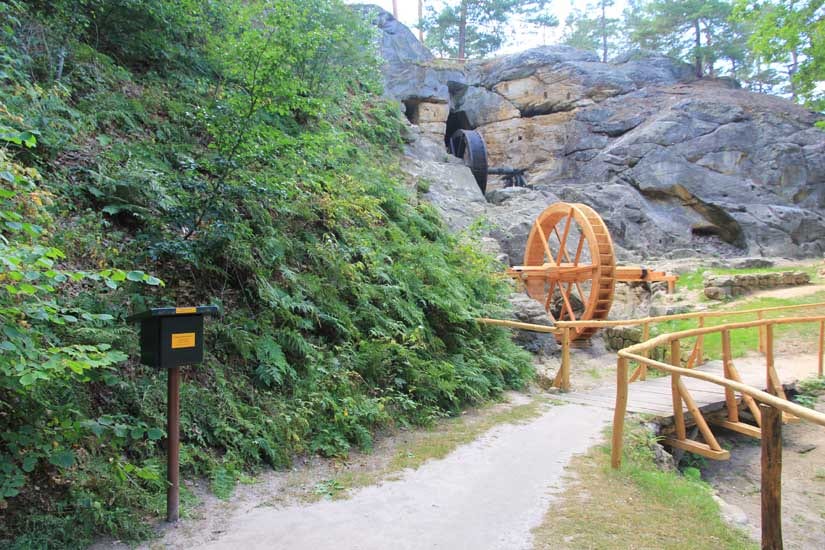
The Regenstein Mill was built at the end of the 12th century and supplied the inhabitants of the castle with flour and oil until the middle of the 15th century. The feed water for the mill wheels was led from the Goldbach stream below the Mönchemühlenteich pond to the Regensteinmühle mill via an almost two-kilometre-long millrace. After this time, the mill fell into disrepair and nature reclaimed the site.
Between 1988 and 1997, the entire mill complex was rediscovered and uncovered by the Blankenburg mining engineer Lothar Tomaszewski and volunteers. Together with ABM workers from a labor market policy measure, two mill wheels were also installed.
However, as early as 2012, new thoughts were given to how this valuable facility could be preserved, as considerable signs of weathering could already be seen on the mill wheels. With the help of the “Municipal Employment Agency” of the Harz district and other network partners, a unique project was developed to preserve this valuable facility. Under the leadership of the VHS-Bildungswerk GMbH, young people from the Harz region worked together with young French people from the “EPIDE” institution in the partner region of Belfort in 2013 and 2014 to rebuild both mill wheels and assemble them on site.
You reach the Regensteinmühle via a narrow signposted path which leads into the forest opposite the parking lot below the ruins of Regenstein Castle HWN 80. It is a good idea to continue the tour to the sand caves HWN 81 in Heers.
The Regensteinmühle was voted the most beautiful stamp site in 2014 by our hiking friends.
